
The Gap: On the Space Between Trigger and Response

This essay is part of an ongoing series in The Collective Brief exploring the inner game of leadership.
Viktor Frankl, writing from the particular darkness of a Nazi concentration camp, observed that between stimulus and response there is a space, and that in that space lies our freedom. I first read that sentence years ago, in a copy of Man's Search for Meaning that still sits on my shelf, and I have returned to it so many times since that it has stopped feeling like something I learned and started feeling like something I always knew. It is perhaps the most compressed and consequential sentence in the literature of human development. And yet most people, living their lives at the speed that modern life requires of them, have never once been introduced to it.
The anthropologist Arnold van Gennep, writing in the early twentieth century about rites of passage, gave us the word liminal, from the Latin limen, meaning threshold. He was describing the in-between state, the moment a person has left one identity but not yet arrived at another. Victor Turner later expanded this into a broader theory of human transformation: that the liminal space is not merely transitional but generative. It is where the old self loosens its grip. Where something new becomes possible.
I have been thinking about liminality in a different register lately. Not the grand threshold of initiation or transformation, but the micro-liminal: the tiny, almost imperceptible space that exists between the thing that happens to you and the thing you do in response. The Stoics understood this intimately. Epictetus taught that it is not events themselves that disturb us but our judgments about events, which implies, necessarily, a moment between the two. Marcus Aurelius, in his private journals, returned again and again to the practice of catching his own impressions before assenting to them. The gap, for the Stoics, was not a passive space. It was the site of all moral agency.
And yet we do not teach it. We reward its opposite. The cultures that high performers inhabit tend to valorize decisiveness, speed, the appearance of certainty. To pause is to hesitate. To hesitate is to doubt. To doubt is, somehow, to be less than what is required.
I know this pressure intimately, because I have spent significant portions of my life submitting to it.
I have a mode, one I have come to think of simply as robot mode, that I can activate with a reliable ritual: skip breakfast, large black coffee, head down. What follows is a particular quality of consciousness that I have genuinely come to love. Mihaly Csikszentmihalyi spent decades studying what he called flow, that state of complete absorption in which the self recedes and the work takes over entirely. Robot mode is my version of this. I do not need to eat. I do not need to stop. I am single track, building things, solving problems, moving through complexity with a frictionless efficiency that feels, in those hours, like a kind of superpower. There is real pleasure in it. A cleanness. The if/then statements fire without negotiation. Input arrives, output emerges, no pause required.
The problem, as I have learned and relearned, is that robot mode has no natural terminus. I know how to turn it on. The off switch is considerably less reliable. Robot mode does not come with a natural invitation to stop. I have to intentionally down regulate, to actively choose to come back to myself, and in the hours when I have not yet made that choice, if someone needs something emotional from me, I am not sure I am always able to give it. Robot mode is optimized for throughput, not presence. It is, in the language of the philosophers, the human doing rather than the human being.
Which is what made a client's words land with such particular force when he said, recently and with a kind of quiet wonder I have not stopped thinking about: "I feel like I'm becoming human. Where I used to feel like I had to be a robot."
He is a tech leader. Married 26 years. Two children who have grown up watching their father navigate the world in a very particular way. He has been in coaching with me for four years, which means I have had a long view of his patterns, and of his work.
For most of those 26 years, he and his wife had inhabited a familiar choreography. Something would trigger him. He would become defensive. She would respond to his defensiveness. It would escalate. His children, he told me, had learned the sequence well enough to leave the room before it properly began. Not because they were frightened, simply because they knew the script and had made their peace with it.
And then, some weeks ago, something shifted. Not dramatically. Not with the retrospective clarity we tend to assign to moments of genuine change. He simply explained to his wife what was happening for him in the moment, rather than following his default programming. Named the thing happening inside him rather than projecting it outward. His wife, hearing this unfamiliar offering, said something that stopped him entirely: that she was no longer the person he had been reacting to either. They resolved it in fifteen minutes. Nobody left the room.
What he had found, without necessarily having a name for it, was the gap. The micro-liminal space between stimulus and response that Frankl identified in Auschwitz, that Epictetus described in his discourses, that Marcus Aurelius practiced in the privacy of his journals. The pause between the if and the then, where something other than habit becomes possible.
He also practices jiu-jitsu, and he described it to me in terms I found immediately recognizable: the discipline of imagining a camera positioned above the sparring session, a third-person perspective that allows you to see the whole rather than simply react to whatever is immediately in front of you. He had been learning, slowly and imperfectly, to apply that same perspective to his own interior life. To become, in a sense, the observer of his own reactions rather than merely their instrument.
I recognized it because I have been trying to do the same thing, with uneven results.
Some months ago, my sons had been teasing me, with the particular relentlessness that small children bring to any perceived vulnerability, about my thinning hair. I had purchased, in a moment of mild vanity, an expensive shampoo. When it arrived, I made the error of allowing them to play in my shower unsupervised. I was just in the next room, listening to them giggle while playing, unaware of what was really going on. I came in to find them beaming with the specific pride of children who have discovered something genuinely wonderful: they had poured the entire bottle across the tiles and were sliding across it. "Look Dada," one of them said, with complete satisfaction, "slip and slide!"
There was no gap. The trigger arrived and the reaction followed with the seamless efficiency of robot mode at its worst. I lost my temper entirely.
I calmed down, though not immediately and not gracefully. I remember standing there asking myself: why am I so mad? Who am I actually mad at? Am I mad at them for playing, for being exactly what children are? I had left them alone in there. I had handed them the opportunity. The answer, when it arrived, was uncomfortable: I was mad at myself. I went back to them, apologized for blowing up, told them they didn't deserve that, and gave them both a hug. We moved on, as families do.
A few days later, my son arrived home from school carrying a piece of black paper covered densely in crayon. Red, orange, green, the lines frantic and layered and going in every direction. He held it out to me with a certain gravity and said: "This is for you Dada. It's your face. Your face when we were slip and sliding."
I laughed. Then I pulled him into a hug and held him there for a moment longer than usual. What I felt was not embarrassment, or the sting of being caught, but something closer to gratitude. This small person had been watching carefully enough to record something I had not seen myself, or had seen and looked away from, and he had given it back to me without judgment, in the only language fully available to him. I remember thinking: I cannot believe you drew this for me. It was, purely and simply, a love moment.
Then I had it framed.
It hangs now as a daily reminder of what the absence of the gap actually looks like, rendered in the honest and unsparing hand of a six year old who was paying closer attention than I knew. When I tried to photograph it recently to share here, I caught my own reflection in the glass of the frame, looking back at myself looking at it. It felt, as these things sometimes do, precisely right.
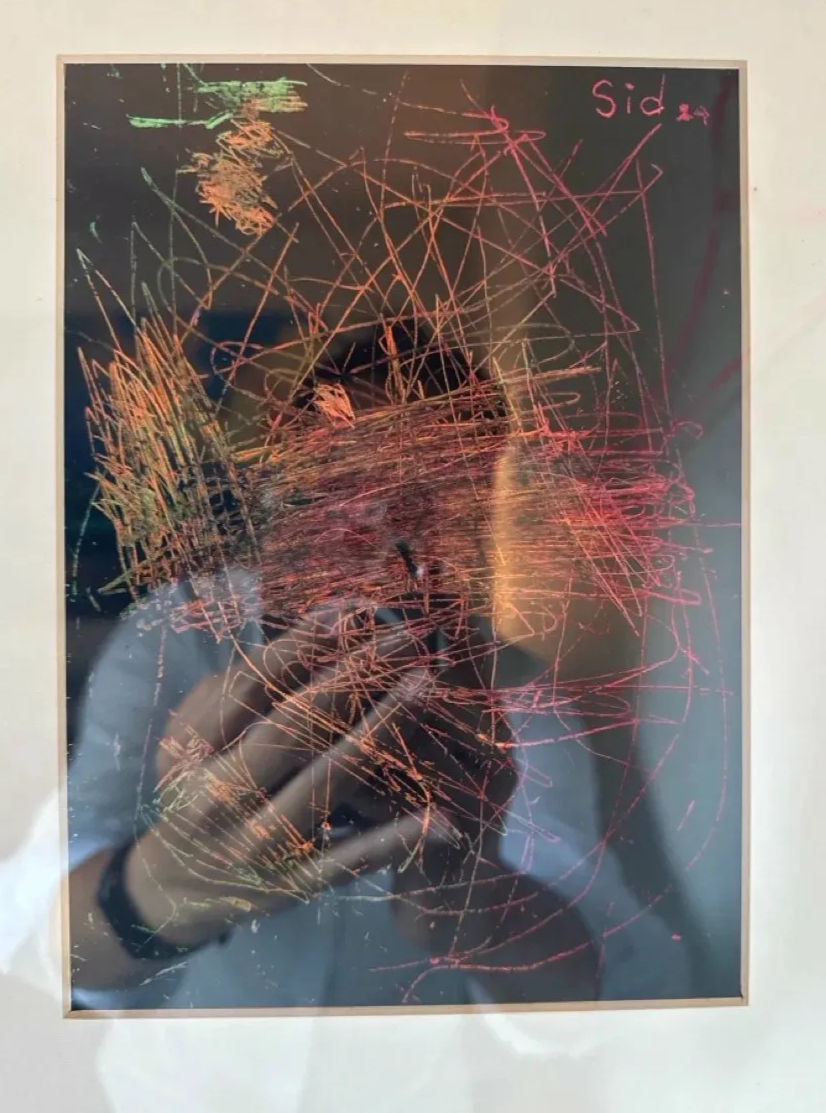
The drawing is not a rebuke. That is the remarkable thing. It was given as a gift, with no apparent judgment, simply as a record of what he saw. Children, before they learn the social graces that teach them to soften their observations, are extraordinarily accurate witnesses. He saw something and gave it back to me. The gap, in that moment of receiving it, was available to me in a way it had not been in the shower. I could have felt accused. Instead I felt seen. That difference, subtle as it appears, is where everything lives.
This is, I think, what the gap ultimately makes possible. Not the elimination of reactivity, which is neither achievable nor, in every circumstance, desirable. But the capacity to witness oneself. To be, even briefly, the camera above the sparring session rather than only the person sparring. To introduce into the otherwise seamless sequence of trigger and reaction a moment of observation that changes, however slightly, what comes next.
Frankl arrived at his insight about the gap under conditions of almost unimaginable duress. Most of us will not be tested so severely. But the gap he described is available, in smaller and more ordinary moments, to anyone willing to look for it. In the shower, with an empty bottle of shampoo and two delighted children. In a conversation with a spouse that has played out, in one form or another, for 26 years. In the moment a new colleague arrives with intimidating credentials and an old story fires without invitation.
The gap does not arrive through understanding it. It is built, slowly and with significant failure along the way, through the repetitive practice of looking for it in the moments when the pattern is already running and every instinct is pointing toward the familiar exit.

My client and I have been at this together for four years. What looks, from the outside, like a different person is simply the same person with more access to himself. More capacity to stand in the threshold, however briefly, before deciding what comes next.
That is, I think, what becoming human actually means. Not the absence of reaction, but the presence of choice.
The gap is where that lives.
If something here landed, I would be glad to hear about it. And if you are curious what this work looks like in practice, you can book a conversation here: https://book.morgen.so/mac


Comments